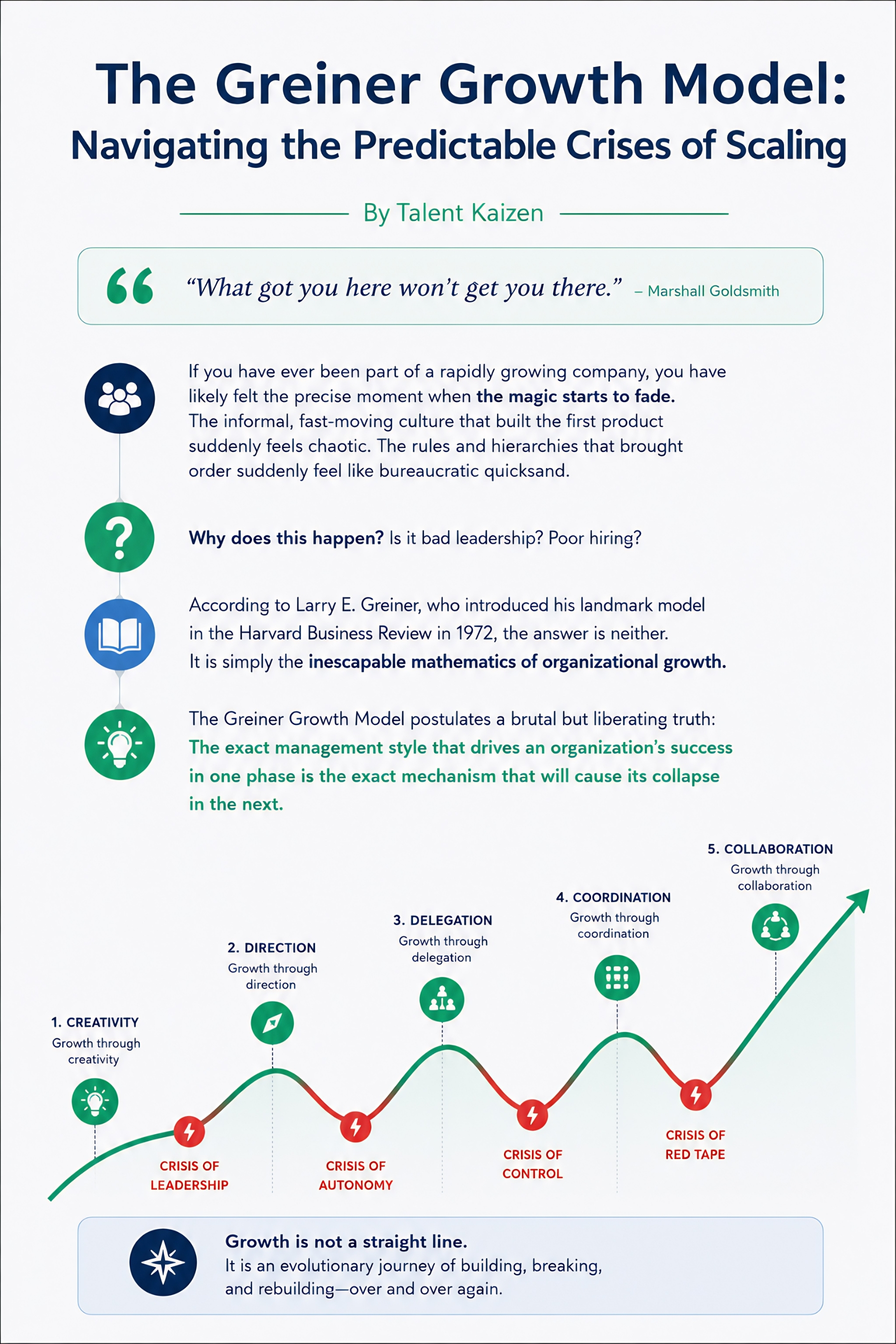
If you have ever been part of a rapidly growing company, you have likely felt the precise moment when the magic starts to fade. The informal, fast-moving culture that built the first product suddenly feels chaotic. The rules and hierarchies that brought order suddenly feel like bureaucratic quicksand.
Why does this happen? Is it bad leadership? Poor hiring? According to Larry E. Greiner, who introduced his landmark model in the Harvard Business Review in 1972, the answer is neither. It is simply the inescapable mathematics of organizational growth.
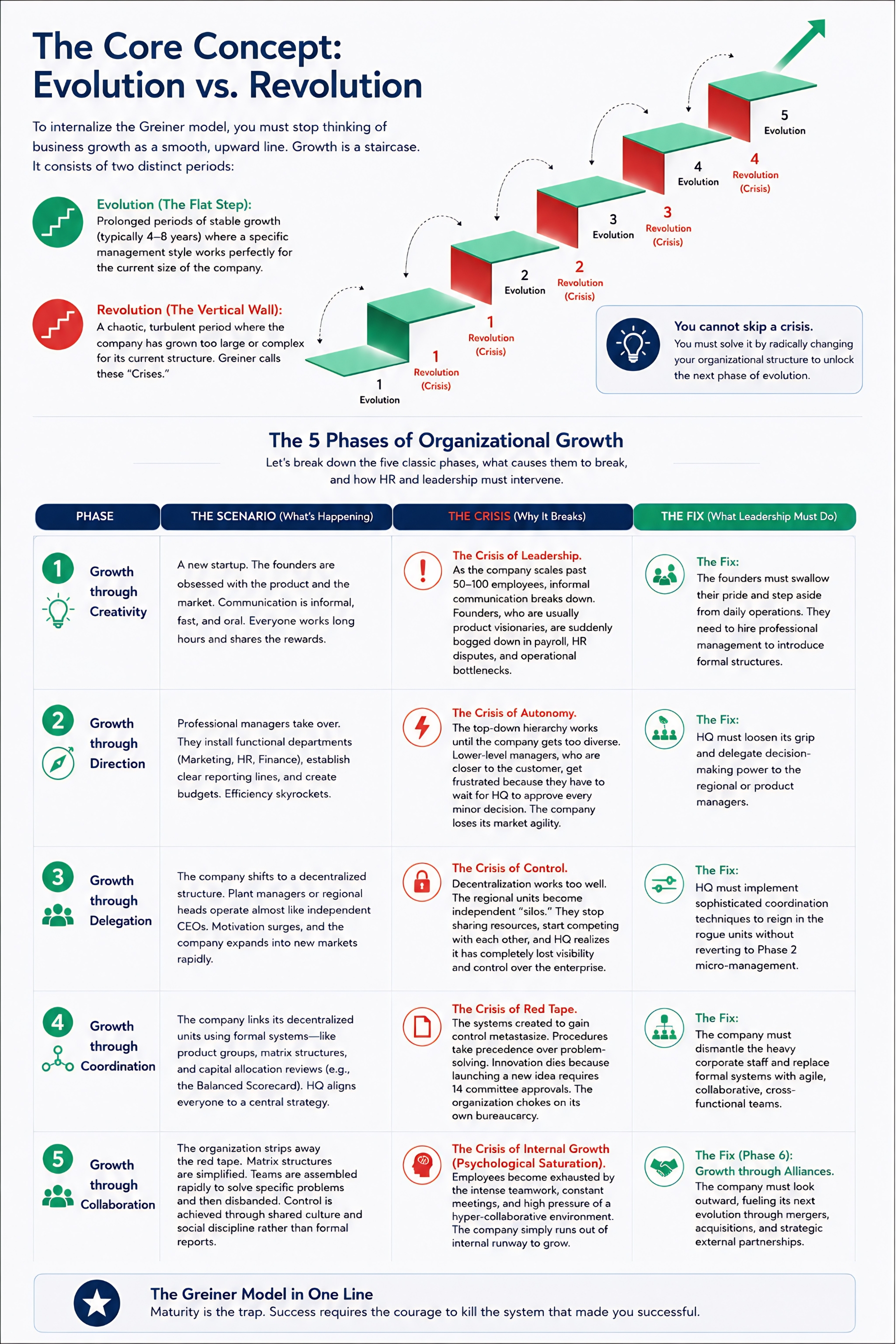
The Core Concept: Evolution vs. Revolution
To internalize the Greiner model, you must stop thinking of business growth as a smooth, upward line. Growth is a staircase. It consists of two distinct periods:
- Evolution (The Flat Step): Prolonged periods of stable growth (typically 4–8 years) where a specific management style works perfectly for the current size of the company.
- Revolution (The Vertical Wall): A chaotic, turbulent period where the company has grown too large or complex for its current structure. Greiner calls these "Crises."
You cannot skip a crisis. You must solve it by radically changing your organizational structure to unlock the next phase of evolution.
Real-World Application: The Apple Journey
To see this in action, look at Apple's history throughout the 1980s and 90s:
- 1. Phase 1 (Creativity): Steve Jobs and Wozniak building in a garage.
- 2. Crisis of Leadership: The company outgrew them. The board brought in John Sculley (a professional manager from Pepsi) to provide Direction (Phase 2).
- 3. Crisis of Red Tape: By the late 90s, Apple was choking on bureaucracy and competing internal silos with dozens of confusing product lines.
- 4. The Fix: When Jobs returned, he slashed the red tape, killed 70% of the products, and instituted a collaborative, highly focused, functional matrix structure (Phase 5) that led to the iPod and iPhone era.
The Talent Kaizen Perspective: HR as the Architect
Most generic management blogs view the Greiner model as a tool for the CEO. At Talent Kaizen, we argue that this is fundamentally an Organizational Development (OD) and HR playbook. The CEO’s job is to focus on market growth. HR’s job is to ensure the organizational chassis doesn't break while the CEO hits the gas.
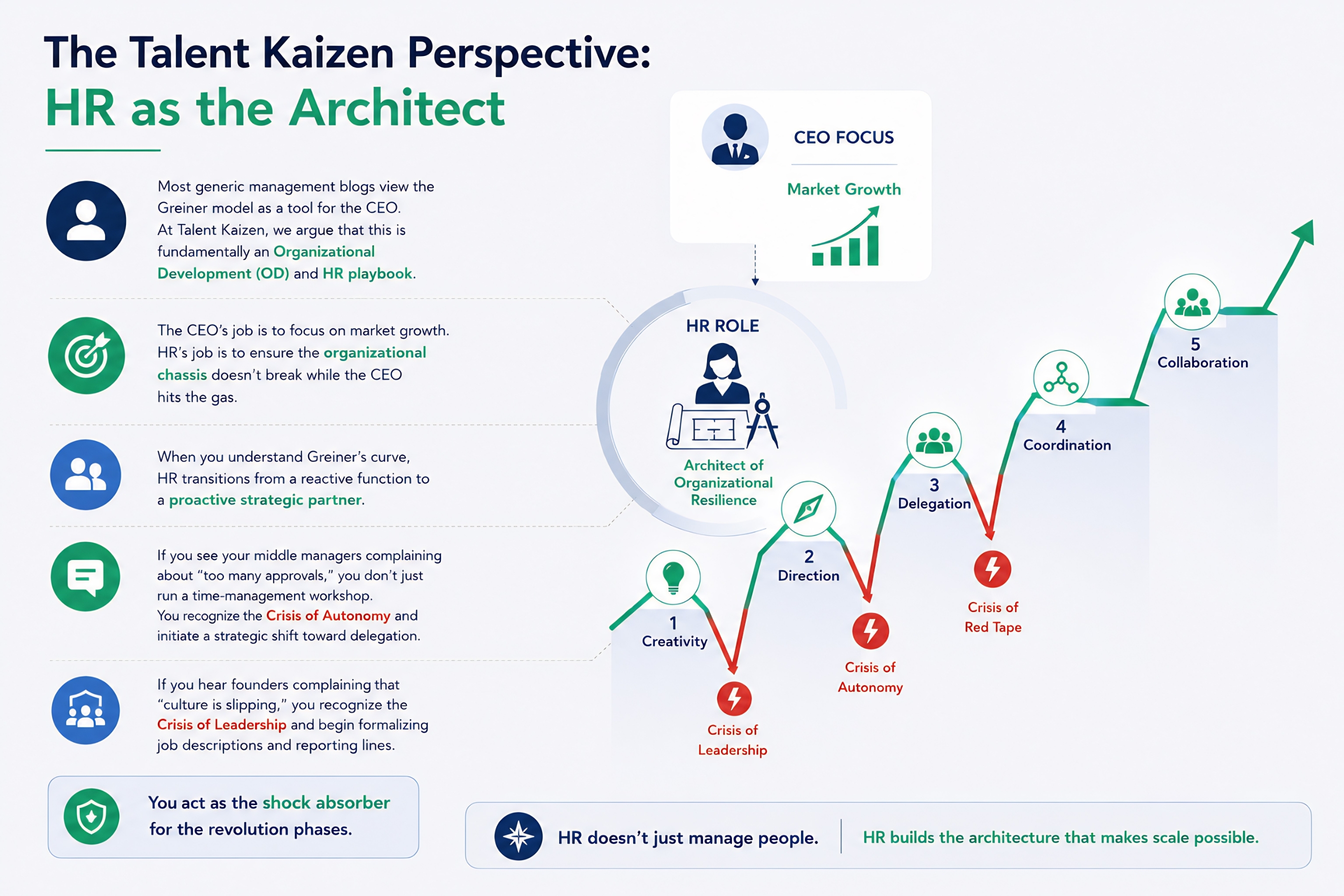
When you understand Greiner’s curve, HR transitions from a reactive function to a proactive strategic partner. Act as the shock absorber for the revolution phases. If you see your middle managers complaining about "too many approvals," you don't just run a time-management workshop—you recognize the Crisis of Autonomy and initiate a strategic shift toward delegation.
Framework Blind Spots
No academic model is perfect. Before applying Greiner’s theory blindly to your organization, you must account for its limitations:
1. The Headcount Fallacy (Tech Leverage)
Greiner formulated this model in 1972, heavily correlating "Size" with human capital. Today, technological leverage breaks this assumption. A modern SaaS startup with 15 employees can possess the operational complexity of a legacy company with 5,000 employees. You must map the model to complexity, not just headcount.
2. The Monolith Myth (Micro-Cultures)
The framework assumes an enterprise moves linearly as a single, unified entity. In reality, modern conglomerates are fractured. A legacy hardware division might be dying of "Red Tape" (Phase 4), while its newly acquired AI software unit operates autonomously like a startup (Phase 2).
3. Macro-Economic Shocks
The curve implies that structural revolutions are triggered internally by the friction of growth. It fails to account for external "Black Swan" events. A global pandemic or a regulatory leap can force a company to radically restructure overnight.
Final Thoughts
The ultimate value of the Greiner Growth Model isn't in perfectly plotting your company on a chart. Its value is in the mindset shift it provides. It teaches leaders to stop viewing growing pains as failures of individual people, and start viewing them as necessary friction points of structural evolution.
When you know a crisis is simply a symptom of success, you can stop panicking, and start restructuring.